

For years, industrial cybersecurity warnings have sounded abstract to many controls engineers.
Keep the PLC network isolated.
Do not expose controllers to the internet.
Patch devices.
Secure remote access.
All sensible advice — but often treated as something for the IT or cybersecurity team to worry about.
That attitude is becoming much harder to defend.
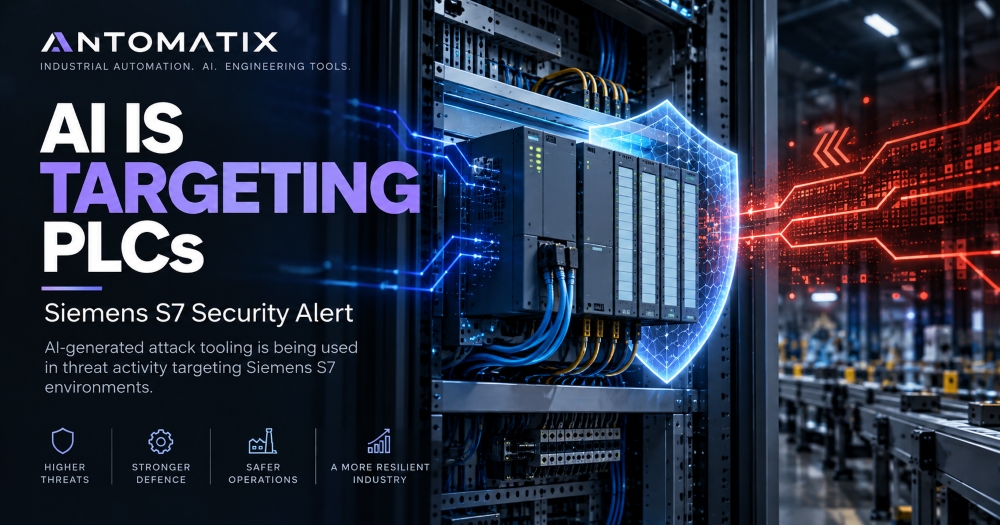
In August 2026, the U.S. National Security Agency and partner agencies issued a cybersecurity advisory warning about an active threat involving Siemens S7 programmable logic controllers. According to the advisory, cyber actors are using AI-generated exploitation scripts disguised as legitimate industrial monitoring tools while conducting reconnaissance and developing capabilities against PLC environments.
Siemens subsequently updated its own security bulletin, explicitly referencing the advisory and recommending that customers strengthen protection around S7 systems. The company’s bulletin notes that the S7-1200 had already been specifically named in earlier threat reporting and that the August advisory expanded the focus to the wider Siemens S7 family.
This matters for far more than Siemens users.
It is an early example of a much bigger change now reaching operational technology:
AI is beginning to reduce the technical barrier required to create tools capable of interacting with industrial control systems.
And that changes the cybersecurity equation for automation engineers.
What exactly has happened?
On 19 August 2026, the NSA announced a joint cybersecurity advisory titled “Defending Against an Active Threat to Siemens S7 Series PLCs.”
The agencies said cyber actors were conducting targeted reconnaissance and capability development against U.S.-based Siemens PLCs and were using artificial-intelligence-generated exploitation scripts presented as legitimate monitoring software. The sectors mentioned include manufacturing, energy, water and wastewater, chemicals, food and agriculture, and commercial facilities.
The advisory is important because it is not discussing a hypothetical laboratory exercise.
Government agencies are warning PLC owners about observed threat activity.
Potential consequences listed by the NSA include:
- disruption of industrial processes;
- equipment damage and downtime;
- safety incidents;
- loss of sensitive information;
- regulatory consequences; and
- wider disruption across interconnected systems.
The agencies also stress that although the advisory focuses on Siemens S7 controllers, PLC targeting is broader than one manufacturer or one controller family.
That is probably the most important sentence for the automation industry.
This is not simply a “Siemens problem.”
It is an OT security problem.
Why AI changes the threat
Interacting with industrial controllers has traditionally required a particular combination of skills.
An attacker might need to understand:
- industrial networking;
- vendor-specific communication protocols;
- PLC architecture;
- controller memory and data structures;
- engineering software;
- machine behaviour;
- industrial processes; and
- how to write software capable of communicating with the target equipment.
That knowledge has not disappeared.
But AI coding systems can dramatically accelerate parts of the process.
Someone who understands the objective can now ask an AI system to help write software, interpret documentation, analyse network behaviour, translate between programming languages, diagnose errors and iterate rapidly on code.
The same productivity improvement that helps a controls engineer build an OPC UA client or a PLC testing utility can also help someone creating malicious tooling.
That is the uncomfortable dual-use nature of AI.
Antomatix has covered how AI is already assisting legitimate PLC engineering through code generation, troubleshooting and project analysis. The same underlying capability — understanding technical documentation and producing usable software — does not automatically know whether the person asking for help is a commissioning engineer or an attacker.
For more on the engineering side of that transition, see AI for PLC Programming in 2026.
This does not mean AI can magically hack every PLC
There is an important distinction.
The existence of AI-generated attack scripts does not mean an AI model can simply point at any S7-1500 and take control of a factory.
Industrial attacks still depend heavily on access, architecture, configuration, credentials, firmware, network exposure and the security controls surrounding the system.
A properly segmented PLC behind controlled industrial networks is very different from a poorly protected controller reachable through an exposed remote-access path.
The danger is that AI can make several stages of the attack process faster and easier.
It can help automate reconnaissance.
It can assist with creating or modifying scripts.
It can interpret error messages.
It can explain unfamiliar protocols.
It can rapidly adapt existing open-source software.
And it can reduce the amount of specialist programming knowledge required to produce a functional tool.
The result is not magical hacking.
The result is lower friction.
In cybersecurity, lower friction matters.
Why controls engineers should care
Many industrial sites still divide responsibility roughly like this:
IT owns cybersecurity.
Controls owns the PLC.
That boundary is increasingly unrealistic.
A PLC does not need to run antivirus software for a cyber incident to affect it.
The path into a control system may involve:
remote engineering laptops → VPN → industrial network → engineering workstation → PLC
or:
corporate network → production server → SCADA → controller network
or:
vendor remote-access gateway → machine network → PLC
The attack surface exists around the controller as much as inside it.
Controls engineers make architectural decisions every day that directly affect cybersecurity:
- which interfaces are enabled;
- whether a PLC web server is required;
- how remote access works;
- whether a machine network can route outside its cell;
- whether default credentials remain in use;
- how engineering laptops connect;
- whether devices are patched;
- how switches and firewalls are configured;
- whether external communication is restricted; and
- which services are exposed.
Cybersecurity therefore cannot be completely delegated to another department.
It is becoming part of normal automation engineering.
Siemens’ own response
Siemens maintains a ProductCERT security bulletin covering increased cyber threats to industrial control systems.
The bulletin was updated on 21 August 2026 following the new PLC advisory.
Siemens recommends keeping devices and systems current, disconnecting equipment from networks with inadequate security or placing additional protections such as firewalls around them, using strong unique passwords, and following Siemens’ industrial-security operational guidelines.
These recommendations are not particularly exotic.
That is actually the point.
A large percentage of industrial cybersecurity still comes down to good engineering discipline.
1. Stop exposing PLCs unnecessarily
A PLC should not be directly reachable from the public internet simply because doing so makes remote support convenient.
Industrial remote access should be deliberately engineered.
That normally means controlled VPN infrastructure, authenticated access, restricted routes and appropriate firewall rules rather than opening the controller itself to external networks.
The NSA explicitly recommends isolating PLC environments from the internet wherever possible.
2. Patch — but patch like an automation engineer
“Install every update immediately” is not always realistic in operational technology.
Updating firmware on a running production system can carry operational risk.
The correct approach is controlled vulnerability management:
identify the installed firmware;
review vendor advisories;
understand the actual exposure;
test updates;
plan downtime where required;
maintain backups;
then deploy through change control.
The important part is that “we never update PLC firmware” cannot remain the default cybersecurity strategy.
Siemens specifically recommends keeping systems at current supported versions to reduce exposure to known vulnerabilities.
3. Disable services you do not need
Every enabled service increases the attack surface.
If a PLC web server is not required, consider whether it should be enabled.
If remote diagnostic access is unnecessary, do not leave it available merely because it is convenient.
This principle is particularly relevant because Siemens has separately disclosed high-severity vulnerabilities affecting S7-1500-related systems. One 2026 advisory concerned a trace-file handling issue in the web interface and carried a CVSS v4 score of 9.4; Siemens advised restricting web-server access and disabling it where unnecessary.
The lesson is broader than that individual vulnerability:
functionality that is not required should not automatically remain exposed.
4. Treat the engineering laptop as part of the control system
The engineer’s laptop can be one of the most powerful devices on an industrial network.
It may contain:
- TIA Portal;
- PLC project files;
- certificates;
- VPN profiles;
- passwords;
- automation utilities;
- network configuration tools; and
- direct access to controllers.
A compromised engineering workstation can therefore be far more valuable to an attacker than the PLC itself.
Good PLC security with poor workstation security is not good PLC security.
5. Know what is connected to the PLC network
You cannot protect an industrial network you do not understand.
A surprisingly useful exercise is simply producing an accurate map:
PLC
↓
managed switch
↓
HMI
↓
drives
↓
remote I/O
↓
SCADA
↓
engineering station
↓
remote-access gateway
↓
other routed networks
Then ask:
Which of these paths genuinely need to exist?
Network diagrams should not be documentation created once during design and forgotten.
They are security tools.
6. Watch for abnormal behaviour
Industrial networks often have an advantage over normal IT networks: their traffic can be relatively predictable.
A PLC communicating with the same HMI, drives and I/O devices every day creates a fairly stable baseline.
Unexpected engineering connections, unusual write operations, unknown devices or communication originating from unexpected subnets deserve attention.
The NSA specifically recommends monitoring industrial-control environments for anomalous or malicious activity.
7. Backups need to be genuinely usable
“PLC backup exists somewhere” is not a recovery plan.
For critical systems, teams should know:
- where the latest offline project is stored;
- which version is currently running;
- how the controller would be replaced;
- which firmware is required;
- how communications would be restored;
- where HMI/SCADA backups are located;
- who is authorised to perform recovery; and
- how long recovery is expected to take.
If a cyber incident occurs at 02:00, that information becomes extremely valuable.
The deeper problem: OT was designed for reliability, not hostile networks
Many industrial protocols and legacy architectures were created in environments where physical access was effectively the security boundary.
That assumption no longer holds.
Factories now contain:
cloud connections, edge devices, remote support systems, IIoT gateways, historians, virtual machines, wireless infrastructure, vendor VPNs and increasingly sophisticated software integrations.
At the same time, PLC platforms themselves are becoming more capable.
Modern controllers provide web interfaces, OPC UA, secure communications, user management and integration with wider engineering ecosystems.
That functionality is extremely useful.
It also means the modern PLC exists inside a much larger software environment than the controllers of twenty years ago.
AI makes both sides faster
There is another reason this story matters.
Only days ago, Rockwell Automation announced that it had joined Anthropic’s Project Glasswing, which focuses on using frontier AI models for defensive cybersecurity and vulnerability discovery.
So we now have two developments happening at the same time:
Attackers are using AI-generated tooling against industrial systems.
and
Industrial technology companies are using AI to find and remediate vulnerabilities.
This is likely the shape of cybersecurity going forward.
AI-assisted attack.
AI-assisted defence.
Human engineers responsible for deciding what is safe to deploy.
That is not very different from the direction we are seeing in PLC programming itself.
Tools such as Siemens’ Eigen Engineering Agent can now work directly with engineering-project context rather than behaving purely as general-purpose chatbots. Antomatix recently tested Eigen inside a real TIA Portal project.
AI is increasingly becoming an engineering participant.
That makes governance more important, not less.
Could AI eventually monitor PLC environments automatically?
This may be where the story becomes particularly interesting for controls engineers.
Imagine an AI-assisted OT monitoring system that understands not just packets, but the automation architecture.
It could potentially know that:
- PLC01 normally communicates with HMI01 and Drive01;
- engineering access normally comes from one approved workstation;
- Motor03 should never be commanded while SafetyZone03 is open;
- a configuration download normally happens only during maintenance windows; and
- a particular controller never normally receives traffic from the corporate network.
Instead of simply saying:
“Network anomaly detected.”
it could say:
“A previously unseen engineering workstation initiated a controller session to PLC03 at 02:17. This device has not communicated with the cell during the previous 90 days.”
That kind of contextual monitoring is where AI could become genuinely valuable in OT cybersecurity.
But it also requires good asset data, good network architecture and good engineering standards.
AI cannot fix a network nobody understands.
Will this change the job of the PLC engineer?
Yes — but probably not in the way people expect.
Controls engineers are unlikely to become full-time cybersecurity analysts.
But understanding basic OT security is becoming as fundamental as understanding industrial Ethernet.
A modern automation engineer should increasingly understand:
- network segmentation;
- remote-access architecture;
- secure PLC configuration;
- vendor security advisories;
- account and credential management;
- firmware lifecycle management;
- secure engineering workstations;
- logging and monitoring; and
- recovery planning.
Those skills sit naturally beside PLC programming.
The controller is no longer an isolated box.
The AI paradox
There is a strange symmetry developing in industrial automation.
We are building AI systems that can generate PLC code faster.
We are building AI agents that can understand entire automation projects.
We are building AI systems that can search for software vulnerabilities.
And attackers are using AI to accelerate the development of tools that interact with industrial systems.
The technology itself is not the strategy.
How it is deployed is what matters.
The automation industry therefore needs to avoid two equally bad reactions:
“AI will solve everything.”
and
“AI is dangerous, so we should ignore it.”
Neither position is useful.
The better response is controlled adoption.
Use AI where it improves engineering.
Validate what it produces.
Protect the systems it can access.
And assume that the people attacking those systems will also become more capable.
What I would check on an S7 system today
If I were reviewing a Siemens installation after reading this advisory, I would begin with ten questions:
- Is any PLC or PLC web interface reachable from an untrusted network?
- Which remote-access paths can reach the automation cell?
- Are controller firmware versions known and documented?
- Have current Siemens ProductCERT advisories been reviewed?
- Are unused controller services enabled?
- Are engineering workstations properly secured?
- Are strong authentication and unique credentials being used?
- Is PLC-network traffic monitored anywhere?
- Is there a verified offline backup of the current project?
- Could the team recover the system without relying on the affected engineering workstation?
If several answers are “I don’t know,” that is the place to start.
Not with AI.
Not with an expensive cybersecurity platform.
With engineering visibility.
Final thoughts
The most significant part of this advisory is not that Siemens PLCs have suddenly become insecure.
They have not.
The significant part is that AI is accelerating the cyber capabilities available to both attackers and defenders.
Industrial automation has spent years becoming more connected.
The next stage has to be becoming more secure.
For controls engineers, that means cybersecurity is moving from an optional specialist subject into normal engineering practice.
The PLC program still needs to work.
The machine still needs to run.
The production line still needs to meet cycle time.
But increasingly, there is one more requirement:
the system also needs to remain trustworthy when somebody is actively trying to interfere with it.
That is now part of industrial automation engineering.
Related Antomatix Articles
AI for PLC Programming in 2026: What Industrial Automation Engineers Need to Know — a practical look at where AI already helps PLC engineers and where human validation remains essential.
Siemens Eigen Engineering Agent: TIA Portal AI Tested — hands-on testing of Siemens’ project-aware AI agent inside TIA Portal.
Agentic AI in PLC Programming & Industrial Automation — how tool-using AI agents could affect engineering, commissioning and support workflows.
Antomatix PLC Forge — Antomatix’s exploration of engineer-controlled AI code generation for Siemens TIA Portal and Allen-Bradley Studio 5000.
Primary sources
The factual security claims in this article are based primarily on the NSA’s 19 August 2026 PLC threat notice and Siemens ProductCERT bulletin SSB-104599.